
Kids->Farming->Life
Thanks for checking us out! Make sure you sign up for our email list to make sure you are notified of stories, news, and offers! Our email subscribers get first dibs on everything we offer.
I brought the kids home from school. Cece began telling me about an experiment they watched online and immediately requested that we try to replicate it here…now.
One of the things I’ve learned about having kids is that their curiosity has a way of dragging you into questions you didn’t expect to be thinking about that afternoon.
After some misunderstandings about what actually happens in the experiment complicated what I needed to search for, we eventually found a demonstration. It wasn’t the same person she saw at school, but I convinced her it was the same thing.
The experiment is simple enough. Four cups of water with red, yellow, and blue food coloring. Three empty cups between them. All connected by folded paper towels. We let it sit and came back about half an hour later to see what happened.
The water began climbing the paper towel and into the empty cups, slowly pulling itself across the fibers as long as the chain of water stayed connected. It worked flawlessly.
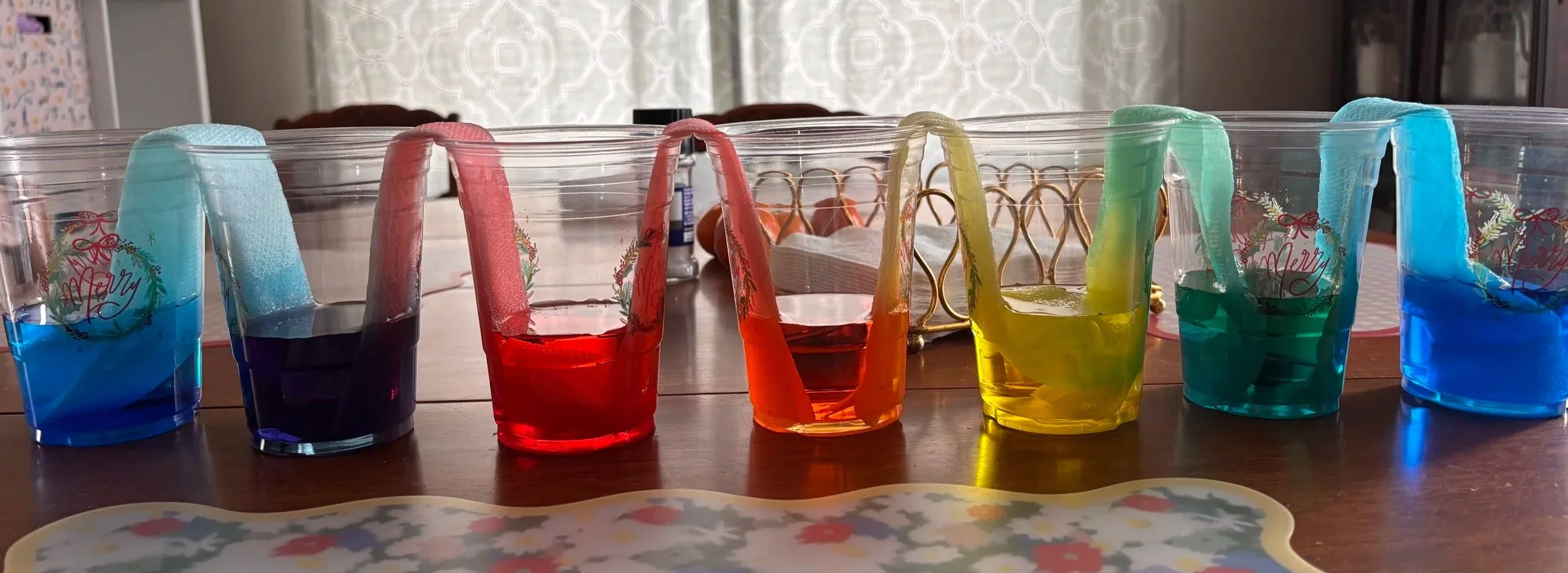
The video explained that capillaries were the reason the water climbed the paper towels, and that plants use a similar system to move water from the roots into the stem. Inside the stem are microscopic tubes called xylem that carry water upward, eventually delivering it to the leaves, flowers, and fruit.
From the first days of my gardening career, the conventional wisdom was to water long and deep so roots grow far down into the soil. A bigger root system leads to bigger plants, which leads to taller stems and larger blooms.
Deep watering makes sense when you’re growing perennials because you expect that plant to live in the same place for years. A large root system will serve it for a long time.
However, about 90% of what we grow are annuals. I need them to perform for a few weeks, produce beautiful stems, and then their job is done.
This past offseason I learned about an irrigation technique called pulse watering. Pulse watering means watering more frequently throughout the day in short 10–20 minute bursts.
Watering this way keeps soil moisture within the range where capillary flow works efficiently, allowing the chain of water from the soil to the root and into the xylem to stay intact. Transpiration is when evaporation from the leaves creates a tiny vacuum which is filled by water through the xylem from the roots. This force is powerful enough to hydrate over a hundred foot tree!
Invisible systems like this are all around us creating what seems like magic. It made me think about the imagery in John 15 of a vine and its branches - life flowing from one to the other as long as the connection holds. Plants are not the only things that depend on staying connected to their source.